It Was Never Just About the Crown
“He had it all. The title, the charisma, the calling. But somewhere along the way, he lost the voice of God, and didn’t even realize it.” “Why King Saul lost God’s favor?”
He had the job, the applause, the respect. Let’s call him James, a community leader, a man of influence, and a pillar of the church. But beneath the surface? Anxiety. Insecurity. Slowly, painfully, James drifted from the presence of God, clinging to position but losing intimacy.
He’s not a made-up story.
He’s all of us at some point.
Because there’s a Saul in every one of us: the part that wants the crown but not the surrender, the influence but not the obedience.
A Crown Without the Spirit
“God gave Saul His Spirit, but Saul gave God only half of his heart.”
Israel wanted a king, “such as all the other nations have” (1 Samuel 8:5, NIV). Though it broke His heart, God allowed it. And Saul looked like the perfect choice; tall, handsome, promising.
But God doesn’t choose the way we do.
Saul was anointed. “The Spirit of the Lord will come powerfully upon you… and you will be changed into a different person” (1 Samuel 10:6, NIV). He had everything he needed to succeed. But when pressure came, he caved.
Instead of waiting for the prophet Samuel before a battle, Saul offered the sacrifice himself. It looked spiritual, but it was disobedience. Samuel told him plainly:
“You have done a foolish thing. You have not kept the command the Lord your God gave you” (1 Samuel 13:13, NIV).
The verdict was in. Saul’s dynasty would not endure.
Partial Obedience is Still Disobedience
“Saul spared what God commanded to destroy, and lost what he hoped to keep.”
“Why King Saul lost God’s favor?”
Saul’s next test was just as clear. God told him to utterly destroy the Amalekites, a long-awaited judgment for their attack on Israel in the wilderness.
But Saul spared King Agag and kept the best livestock. His excuse? “We were going to sacrifice it to the Lord.”
Samuel’s reply still echoes:
“To obey is better than sacrifice, and to heed is better than the fat of rams” (1 Samuel 15:22, NIV).
Saul’s obedience was partial. His repentance was shallow. He cared more about saving face than surrendering his heart.
When the Spirit Leaves the Room
“You can still have the title… and yet not have His presence.”
Then came the moment no leader ever wants to face.
“Now the Spirit of the Lord had departed from Saul, and an evil spirit from the Lord tormented him” (1 Samuel 16:14, NIV).
The Spirit that once empowered Saul was gone. At the same time, God’s Spirit came powerfully upon David:
“From that day on the Spirit of the Lord came powerfully upon David” (1 Samuel 16:13, NIV).
The torch had passed.
Though Saul still sat on the throne, the presence had shifted. And in the void left behind, a tormenting spirit filled the space. Some scholars say it was psychological. Others say spiritual. But one thing is clear: when God’s presence departs, torment is never far behind.
Ironically, the one who brought Saul relief was David, playing the harp, soothing the very man he was destined to replace.
The Long Fall on Gilboa
The final tragedy played out on Mount Gilboa.
Israel’s army was routed. Saul’s sons, including faithful Jonathan, were killed. And when Saul was wounded by archers, he fell on his own sword to avoid capture.
“So Saul took his own sword and fell on it” (1 Samuel 31:4, NIV).
No prophet spoke. No miracle saved him. No glory surrounded his death.
And yet, there was a flicker of honor.
The men of Jabesh Gilead, whom Saul had once rescued, retrieved his body and buried it with dignity. And David, his successor, mourned him with sincerity: “Saul and Jonathan, in life they were loved and admired, and in death they were not parted” (2 Samuel 1:23, NIV).
What This Means for Us
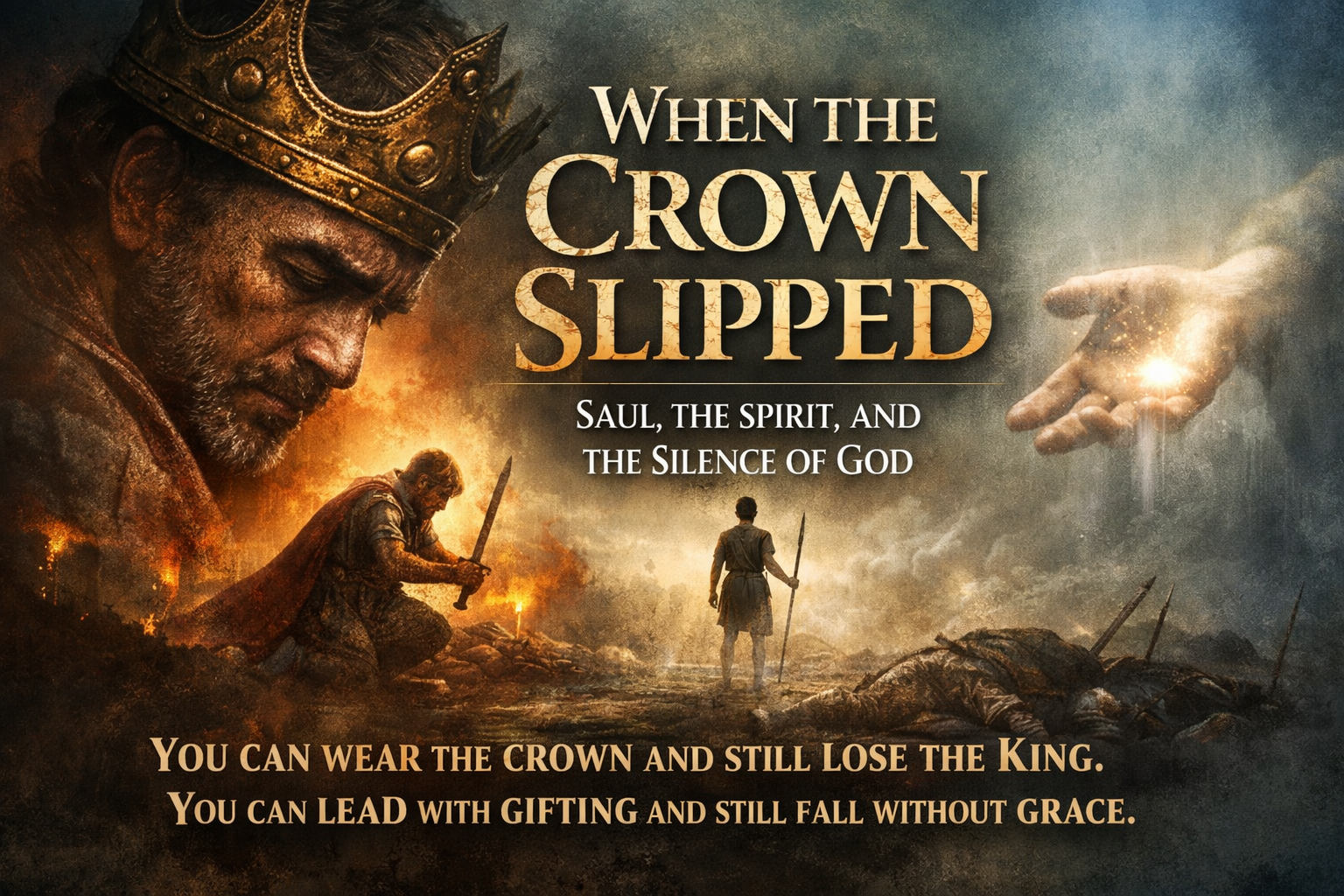
“You can wear the crown and still lose the King. You can lead with gifting and still fall without grace.”
Saul’s story is not just ancient history. It’s a warning light for every believer, every leader, every soul called by God.
We’re not just called to start well, we’re called to finish with faithfulness.
You can have charisma and still lose character.
You can have a calling and still lose the presence.
You can even be anointed and still disobey.
But the message of Saul’s life isn’t just a warning. It’s an invitation:
To return.
To surrender.
To obey fully, not partially.
To value His presence over every position we hold.
If this post spoke to your heart or challenged your thinking, don’t keep it to yourself. Share it with someone you care about. Let’s start a conversation rooted in truth and grace.
Subscribe to our blog for more biblically grounded content on theology, church life, and Christian living.
Get insights, devotionals, and exclusive articles sent straight to your inbox.
Have thoughts or questions? Leave a comment below. We’d love to hear from you.
Closing Prayer: Keep Us Faithful
Father,
Thank you for the sobering story of Saul. You called him. You anointed him. Yet he chose fear over faith and control over obedience.
We ask You now: search us.
Reveal the parts of our hearts where we’ve compromised.
Where we’ve chosen performance over presence.
Where we’ve feared people more than we’ve feared You.
Lord, we don’t want crowns without Your voice.
We don’t want influence without intimacy.
We don’t want to lead without You leading us.
Fill us afresh with Your Spirit.
Give us the heart of David; soft, repentant, and faithful.
May Your presence never depart from us.
In Jesus’ name we pray,
Amen.
Support efforts to help others grow in faith and imagine what church could be.
Share this post: on Twitter on Facebook